AI seats or tokens: calculate total cost without a false comparison
A reproducible way to compare a per-seat plan with usage billing, without confusing list price with total cost.
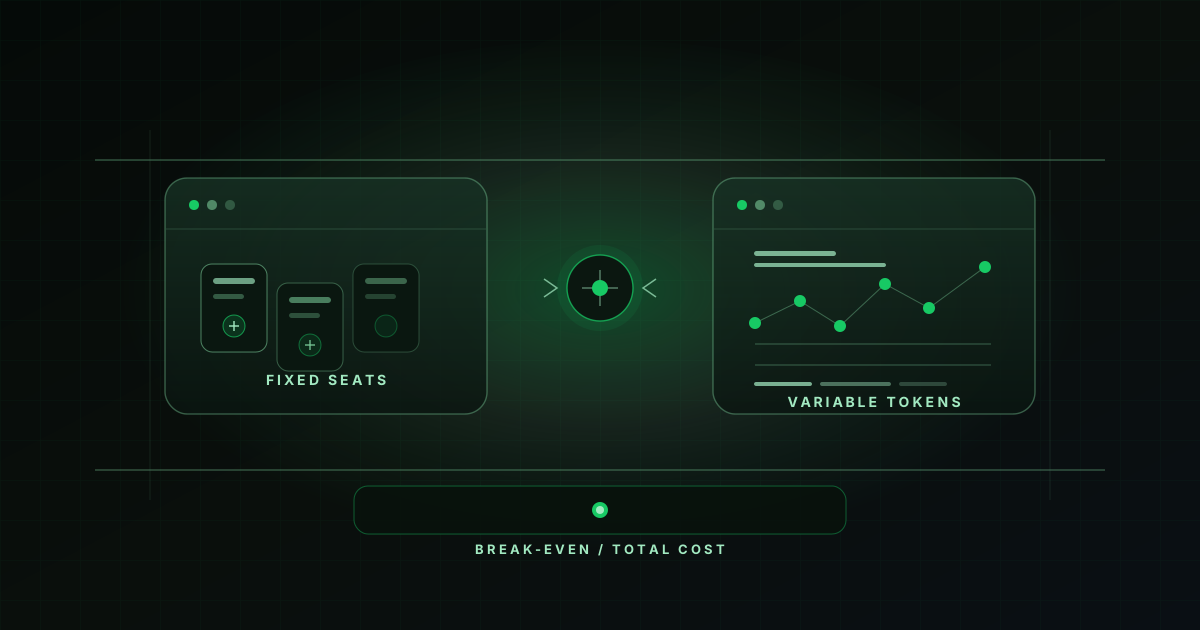
To choose between a per-seat assistant and token-metered service, first compare the full monthly cost per accepted output, on the same scope and quality bar. A seat price is not the cost of the whole stack: a productivity suite may remain an additional expense, while a usage-based API also needs integration, controls, operations, and human review. The break-even point depends on actual volume, not a universal rule.
The worked example below uses invented assumptions; it is not a customer measurement or a vendor quote. Replace every assumption with your contracts, invoices, and a business-task sample. For the broader budget context, see mutualising AI costs; this article builds the operational worksheet.
Separate fixed from variable
A seat, a base software plan, pooled credits, and a token may not cover the same scope.
1. Define the same service before comparing it
Choose a bounded task, such as preparing an internal summary for an employee to review. Specify eligible users, permitted data, languages, acceptable turnaround, minimum quality, retention, and verification rules. Count accepted outputs, not calls: a rejected, regenerated, or corrected answer still consumes resources and time.
Commercial plans illustrate different pricing structures, not automatically interchangeable products. Microsoft distinguishes Copilot Chat for eligible Microsoft 365 subscriptions, a per-seat Copilot add-on, and metered use for some agents. Dust describes seats and credits, with pooled credits on some plans. ChatGPT Enterprise is sold on an annual per-user quote and may include credits. Claude Enterprise distinguishes a base seat price from usage billed at API rates. Inclusions and terms can change; verify the current pages and contract before purchasing.
Create two cost columns in the worksheet. Fixed: seats, any base licence, minimum commitments, annualised integration and operations, gateway, observability, support, and administration. Variable: overages or extra credits, input and output tokens, repeated calls, volume-driven infrastructure, and human review. Avoid counting existing costs twice; distinguish incremental spend from fully loaded cost.
2. A break-even point anyone can reproduce
Fictional assumptions for illustration, all in euros per month:
- Plan A: 100 seats at €40 per month, or €4,000 fixed. Any required productivity-suite base licence is excluded here and must be added if it differs between options.
- Service B: €500 fixed for monthly allocated integration and operations; 3,000 input tokens and 500 output tokens per attempt.
- Service B calculation rates: €2 per million input tokens and €8 per million output tokens. These are invented working assumptions, not a vendor's current quoted prices.
The variable cost per B attempt is (3,000 × €2 / 1,000,000) + (500 × €8 / 1,000,000) = €0.01. For N attempts per month, B therefore totals €500 + €0.01 × N. It equals A at (€4,000 − €500) / €0.01 = 350,000 attempts per month.
At 4,000 attempts, B costs €540 under these assumptions alone. That does not establish that B is “better”: both options must deliver a comparable service. If the seat plan includes more functions, a different quality level, or a service commitment, add that value and cost to the scope. If a plan has credit limits or overages, model them as variable costs rather than assuming unlimited use.
3. Turn the invoice into the cost of useful work
The denominator changes the interpretation. If 4,000 B attempts produce 3,200 accepted outputs, the illustrative cost per accepted output is €540 / 3,200 = €0.169. Including retries matters: 4,000 billed calls do not mean 4,000 completed tasks. For a seat plan, also divide its fully loaded monthly cost by accepted outputs for the same task and period.
Repeat the calculation by team or task category, without arbitrarily allocating an unused seat plan. Report usage results separately from shared-cost allocation; this makes chargeback explainable, especially when shared fixed costs coexist with variable consumption.
The meter is the outcome
Track attempts, retries, acceptance, and full costs within one scope before extrapolating.
4. Decide without betting on one volume forecast
Break-even is an assumption, not a forecast. Vary active users, attempts per person, context length, acceptance rate, and review effort. Test a quiet month, a peak month, and doubled adoption. Input and output rates can differ; caching, batch use, model selection, and retries can also change the invoice. Use the applicable rate card, not a remembered price.
Measure a controlled sample, then reconcile its volume with logs and invoices. An AI Gateway routing layer can standardise identity, budgets, and telemetry, but it cannot replace a quality definition or clear allocation of shared expenses. A hybrid choice may make sense: seats for regular individual use, measured consumption for a specific application.
Keep a small assumptions register beside the worksheet: source, owner, date, and confidence for each input. Label quoted contract rates separately from estimates such as shared support time. When an existing base licence serves other work too, show both the full allocated cost and the incremental cost of the AI option; neither view alone answers every purchasing question.
The right decision is the one whose total cost remains legible across scenarios and meets security, quality, and availability requirements. Record assumptions, the break-even calculation, and what must be remeasured at the quarterly review. That is a defensible TCO; multiplying a displayed rate by account count is not.
Keep reading
Mutualizing enterprise AI cost: budget governance and a vendor-agnostic central layer
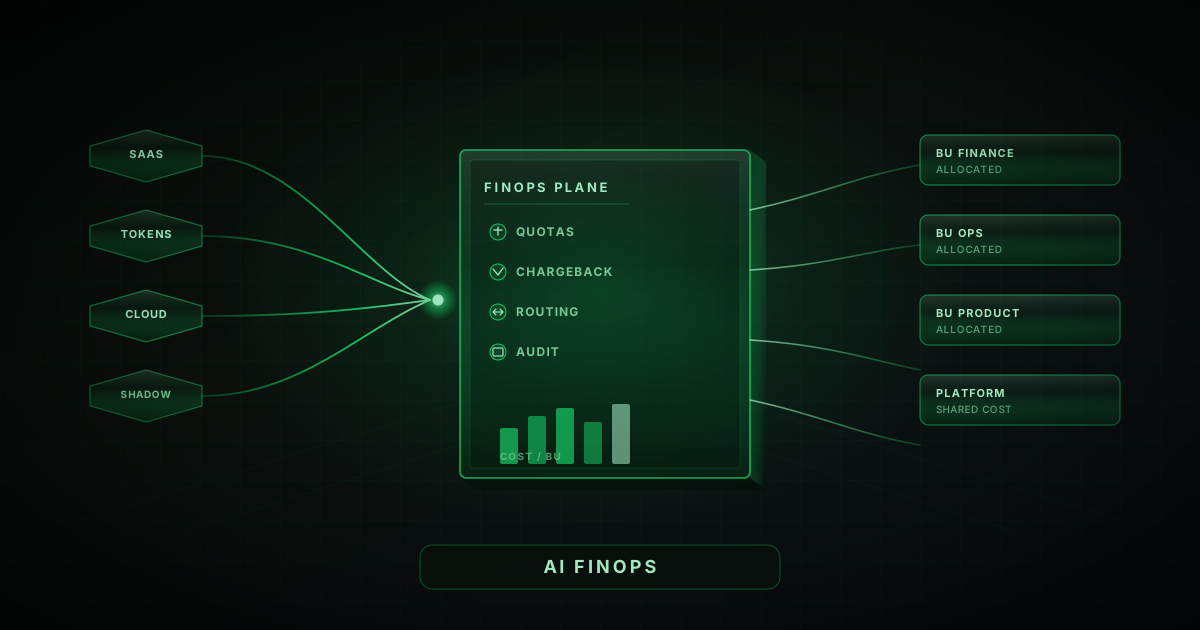
SaaS seats, API tokens, business clouds, and shadow AI: without a central layer, AI spend stays a pile of contracts. AI for leaders recenters quotas, chargeback, and audit.
By Alexandrine Marjollet · September 22, 2026
Why an AI Gateway becomes the control plane of your AI stack
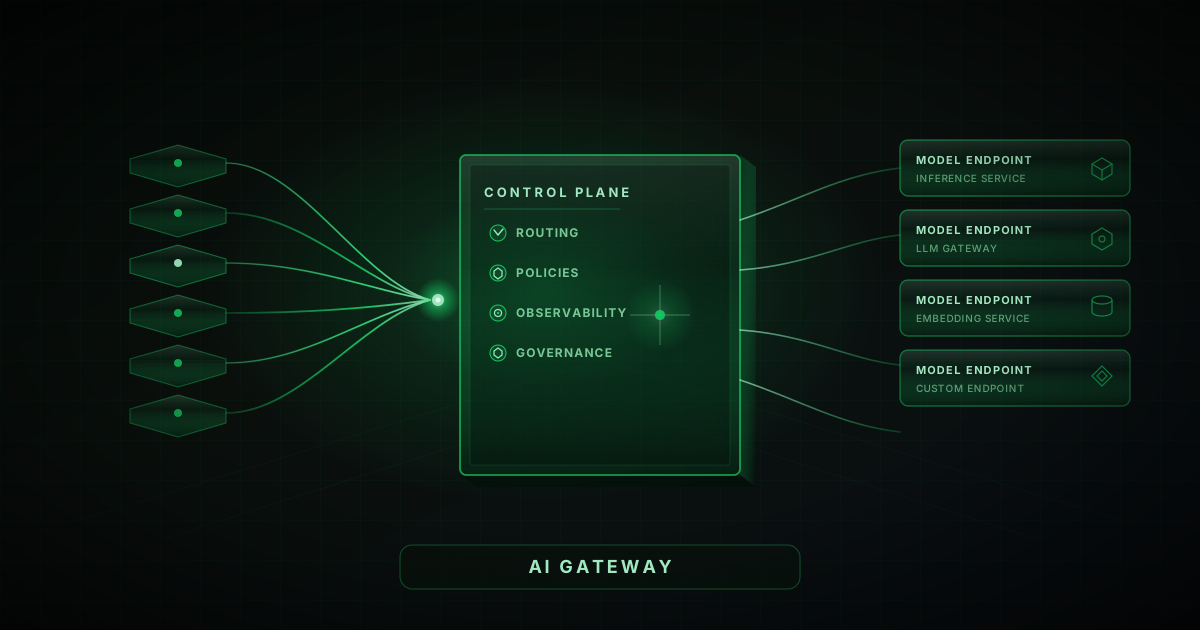
As models and tools multiply, without a single choke point Shadow AI moves to the LLM layer. An AI Gateway recenters auth, quotas, routing, and audit.
By Florian Gabon · September 21, 2026
Central AI layer, embedded suite AI, or build: a decision matrix for the CIO
The PoC proved the use case. The next decision is ownership: build it, take AI already inside business suites, or hold a vendor-independent central layer the enterprise controls.
By Alexandrine Marjollet · October 9, 2026