Mutualizing enterprise AI cost: budget governance and a vendor-agnostic central layer
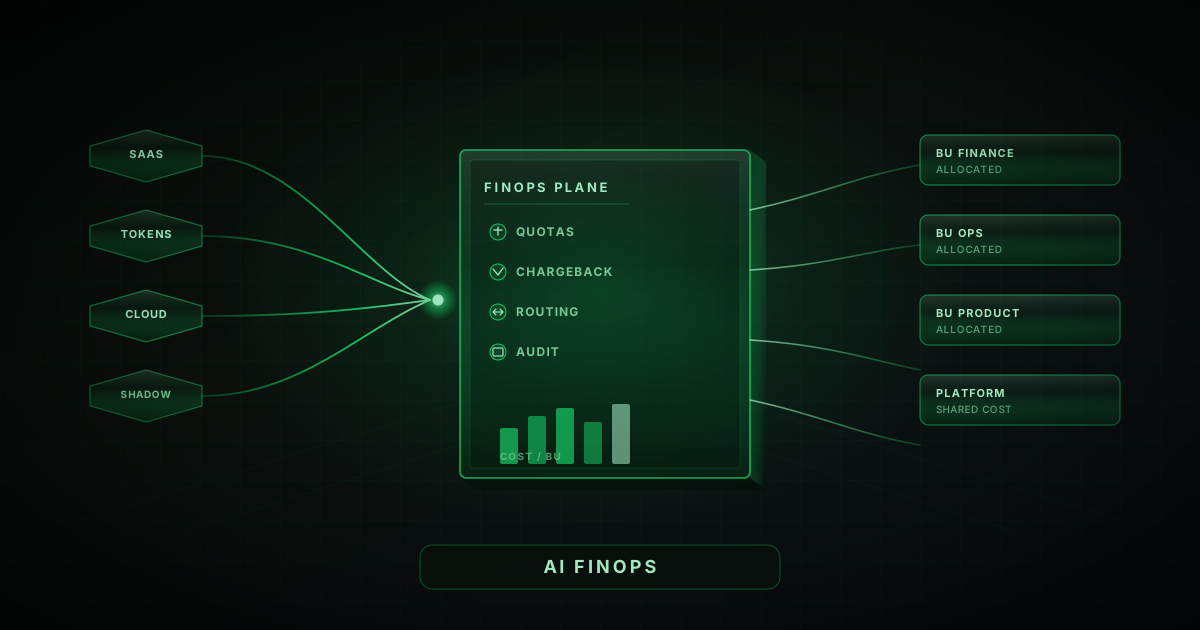
SaaS seats, API tokens, business clouds, and shadow AI: without a central layer, AI spend stays a pile of contracts. AI for leaders recenters quotas, chargeback, and audit.
Fragmented AI invoices: new stakes for traceability and financial steering
Enterprise AI cost is steered by reconciling per-seat contracts, token consumption, and operating expenses, then dividing the total by work actually accepted. Without a shared scope, licences, cloud invoices, PoC API accounts, and off-catalogue assistants form a total that is hard to allocate or compare. A central measurement layer makes spend visible by team and actionable before close.
For a concrete break-even calculation between seats and usage, read AI seats or tokens: calculate TCO. To compare models beyond their displayed rates, see choosing an AI model by the cost of an accepted output. These operational guides complement this article's budget framework.
This is not a simple procurement issue. It is a failure of AI budget control: no structured mutualisation, no reliable chargeback, no homogeneous measurement of cost and footprint on a comparable perimeter. Business teams advance at the pace of use cases, spend fragments, and the invoice aggregates in silence. When governance steps in, it no longer steers the trajectory: it tries to reconstruct it.
From scattered contracts to shared cost
One choke point to measure, cap, and allocate AI consumption, without blocking business innovation.
Why sprawl breaks budget governance
Without a central layer, every team negotiates “its” model, “its” licence, and “its” endpoint. SaaS seats stack on top of token-billed API calls, GPU spend in business clouds, and shadow AI (personal accounts, untracked plugins). The FinOps Foundation has long described what CFOs already know on the infrastructure side: you cannot optimise what you cannot see, and you cannot mutualise what has no shared meter.
The same blind spot exists on the AI side. No shared chargeback reference today lets IT, Finance, and the business units discuss costs on a common base. Technology choices are no more compared on an equivalent perimeter: a premium model or a lighter one, same use case, same service level, yet no truly comparable reference cost. Without an in-month monitoring mechanism, drift is only detected once the spend is already committed.
The AI budget then ceases to be a steered portfolio and becomes an accumulation of contracts, consumption lines, and exceptions.
A constellation of off-catalogue tools does not only complicate the P&L reading: it also weakens the organisation’s ability to document its uses, controls, and responsibilities under the EU AI Act. The more spend is dispersed, the harder compliance elements are to consolidate. In AI, financial opacity and risk opacity often advance together.
AI for leaders as the FinOps control plane for AI
A multi-vendor central layer changes the steering logic. Applications, agents, and RAG flows rely on a stable internal interface, while routing arbitrates in real time among models according to explicit rules: cost, performance, latency, or data residency.
Quotas then frame consumption by team and by environment, before drift turns into a budget overrun. Consumption journals finally provide the traceability chargeback requires: who consumes, what, for which project, in which volume, and at which cost.
The stake is therefore no longer only to centralise access to models; it is to transform diffuse consumption into an observable, controllable, and attributable portfolio.
This is not an accounting proxy bolted on afterwards. It is the same reflex as an AI Gateway: one choke point where authentication, policies, budgets, and compliance elements attach. AI for leaders extends that control plane toward the financial and operational reading the executive committee expects.
Quotas. Explicit limits before the surprise invoice, with alerts IT and Finance can act on.
Chargeback. Credible allocation by business unit or cost centre, on a measured base rather than a year-end allocation key invented under pressure.
Multi-model routing. Business apps keep a stable API; the platform chooses Claude, GPT, a European model, or on-prem by policy. Switching vendors becomes a route change, not a six-month rewrite.
Audit. One journal, correlatable with the session, ticket, or project, ready for the committee and for internal control.
Board-level steering, not vendor dashboards
A readable AI budget, caps per BU, and the ability to switch vendors without rewriting business apps.
What the executive committee must be able to decide
The message to take to the executive committee is simple: the organisation must move from an accumulation of AI contracts to a mutualised, steerable, and auditable portfolio. In concrete terms, that rests on three key capabilities:
First, shared budget governance. The CFO and CTO see the same consumption, the same caps, and the same variances. Business units receive chargeback they can challenge on facts, not on an opaque key. Cloud FinOps practices (visibility, allocation, optimisation) finally apply to LLM traffic, in line with continuous governance loops in the NIST AI RMF.
Second, a link between FinOps and green IT. Measuring cost per request or use case also opens a footprint reading: lighter models when the task allows, off-peak batching, avoidance of redundant calls. Without a shared meter, “green AI” remains an intention; with a central layer, it becomes a policy lever, on the same footing as budget.
Third, vendor independence without freezing innovation. Mono-vendor lock-in is not only commercial: it becomes technical as soon as every product embeds a single SDK. A vendor-agnostic layer lets teams experiment while keeping cutover and dual-run levers. That aligns with a trusted AI layer: same perimeter, same compliance elements, same control capabilities.
Mutualising is not centralising to slow everyone down
The most common fear is that mutualisation slows business teams and compromises their agility. Well designed, a multi-vendor platform produces the opposite effect.
Teams gain simpler access to models, through an internal API and reusable policies, with direct visibility on their consumption: IT recovers an operational control lever, Finance finally obtains a consolidated cost trajectory, and the CISO benefits from usable traces to document controls and uses.
Mutualisation therefore does not remove freedom from the business: it mainly eliminates duplication. The organisation stops negotiating and steering twenty contracts for the same technological capability, and starts managing a common AI service.
AI for leaders does not seek to impose a hosting model or to exclude cloud, European, or on-premise providers. It places them within a single enterprise framework, with rules, responsibilities, and a consolidated reading of costs.
The catalogue can keep expanding without governance complexity growing at the same pace. That is the shift from a succession of exceptions to a genuine IS service: governed, measurable, and attributable, with a P&L that is finally readable.
Conclusion
AI spend fragmented across SaaS, token consumption, business clouds, and off-catalogue uses makes the budget hard to consolidate, chargeback loses reliability, and the real cost of AI remains partially invisible.
Without a central control layer, the organisation has neither genuine mutualisation, nor comparable measurement of cost and footprint, nor a structural lever to limit dependence on a single vendor.
AI for leaders provides that control plane: quotas, multi-model routing, chargeback, and audit so the executive committee can steer a consolidated, traceable, and controlled AI cost, rather than endure an addition of contracts and dispersed consumption lines.
To compare models by cost and quality on a defined task, read the cost-per-accepted-output protocol; to calculate a break-even point between seat and usage billing, see the seats-versus-tokens TCO worksheet. For the technical choke point, Why an AI Gateway becomes the control plane of your AI stack. For the platform frame, AI for leaders as a trusted AI layer. For the regulatory compliance angle, EU AI Act: practical compliance.
Keep reading
AI for leaders as a trusted AI layer inside the IS
Shadow AI, prompt leakage, unsanctioned tools: the real risk is not the model, it is the missing controlled layer in the information system.
By Florian Gabon · September 11, 2026
Why an AI Gateway becomes the control plane of your AI stack
As models and tools multiply, without a single choke point Shadow AI moves to the LLM layer. An AI Gateway recenters auth, quotas, routing, and audit.
By Florian Gabon · September 21, 2026
EU AI Act: practical compliance for the enterprise
Risk classes, duties, evidence. What the AI Act changes once AI is actually in production.
By Florian Gabon · August 4, 2026