Why an AI Gateway becomes the control plane of your AI stack
As models and tools multiply, without a single choke point Shadow AI moves to the LLM layer. An AI Gateway recenters auth, quotas, routing, and audit.
Shadow AI no longer stops at chatbots: It starts with API keys.
One team wires Claude, another calls GPT directly, a RAG PoC still points at a “temporary” endpoint with a key in a .env file: Nobody meant to bypass IT. Six months later, nobody knows which models run, on which budget, over which data, or how to cut a vendor without breaking three business apps.
On the tool and connector side, we already debate this with MCP and a governed catalogue (Enterprise MCP without Shadow AI). On the model side, the same gap exists: without a single choke point, every application reinvents auth, timeouts, model choice, and logs. That is Shadow AI, LLM edition.
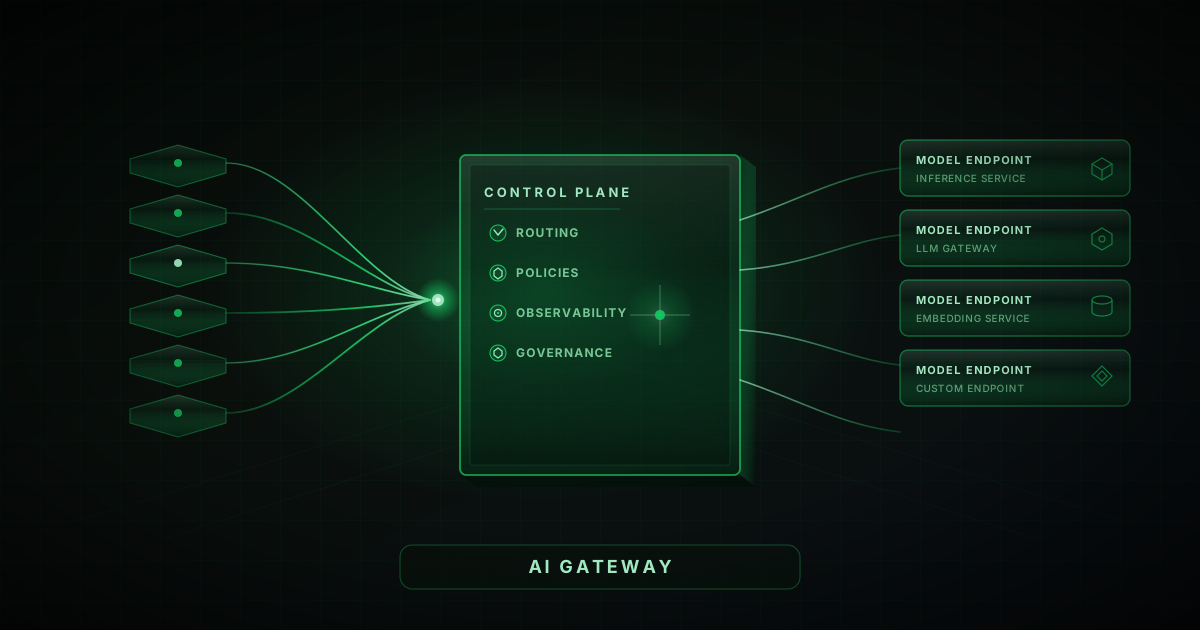
An AI Gateway is that choke point; it is not a disposable proxy for show. It is the control plane of the AI stack: auth, quotas, multi-model routing, policies, audit. A piece of the trusted AI layer, not an integration gadget.
One choke point
Apps, agents, RAG, and batch traffic share one door: same rules, same logs, same lever to cut or switch.
Why model sprawl breaks the IS
The enterprise model catalogue is no longer one vendor. Teams mix cloud APIs, European models, on-prem weights, and specialty models for code or documents. Every product wants “its” best model of the week. Without a gateway, that diversity turns into debt: different SDKs, scattered keys, opaque billing, no way to compare cost and quality on a shared baseline.
Thus, the gateway recenters traffic where the application talks to a stable API. Behind it, routing picks Claude, GPT, or a local model based on policy, load, cost, or data residency. Switching vendors becomes a route change, not a business rewrite. Same idea as a classic API gateway, applied to LLMs: a stable contract upstream, freedom of manoeuvre downstream.
What an AI Gateway actually centralizes
Identity and access. Who may call which model, for which project, with which scopes, without shared keys in repos.
Quotas and budgets. Limits per team, app, and environment, so overruns show up before the surprise invoice.
Routing. Explicit policies: default model, fallback, A/B, residency constraints, emergency cutover.
Audit. One journal: who asked what, to which model, with which token count and status, correlatable with the agent session or ticket ID.
Without that, every team “governs” in isolation. With it, IT and the CTO have one place to restrict, cut, or mandate a sovereign model without hunting keys in Slack.
Vendor independence
Business apps keep a stable API. Routing decides Claude, GPT, or on-prem. Cutover is no longer a six-month project.
Vendor independence is not a slogan
Vendors keep reshaping your LLM contracts and pricing in ways that undercut your strategy and put sovereignty requirements at risk (why sovereign AI matters). If every application embeds a single cloud SDK, lock-in is technical as much as commercial.
The gateway must sit in your IS so it can reverse that dependency and let products consume “the company’s LLM service” without putting confidentiality at risk. Behind it, the platform can switch, dual-run, or reserve some workloads for on-prem; that is not anti-cloud: it is control-plane thinking, the same as for network or identity. Workflow tools such as n8n still help with business orchestration (n8n vs AI for leaders); the gateway governs access to models.
Observability and governance: one journal, one budget, one switch
A risk committee does not want twenty vendor dashboards. It wants consumption, errors, spikes, and the ability to say “cut this model for this app” without opening tickets at three vendors.
That is also where the gateway meets AI for leaders' trust frame: the same audit, perimeter, and evidence expectations as for MCP tools. Frameworks such as the NIST AI RMF stress inventory, measure, and control. An AI Gateway gives a technical hook to hold that loop on LLM traffic, just as MCP does on the tool side.
Link to AI for leaders: part of the layer, not a disposable proxy
A reverse proxy in front of OpenAI is not a strategy. An AI Gateway worthy of the IS carries policies, identity, budgets, and evidence. In AI for leaders it sits inside the trusted AI layer: the same reflex as the tool catalogue, applied to models. Agents and workflows (enterprise AI agents) then consume a controlled internal service, not a mosaic of endpoints.
Conclusion
Model sprawl without a single choke point recreates Shadow AI, this time on the LLM side. An AI Gateway recenters auth, quotas, routing, and audit, lets you switch vendors without rewriting business apps, and gives IT a real kill switch. This is not an infra detail: it is the control plane of the AI stack, a brick of the trust layer.
For the tools and Shadow AI angle, reread Enterprise MCP. For the platform frame, AI for leaders as a trusted AI layer.
Keep reading
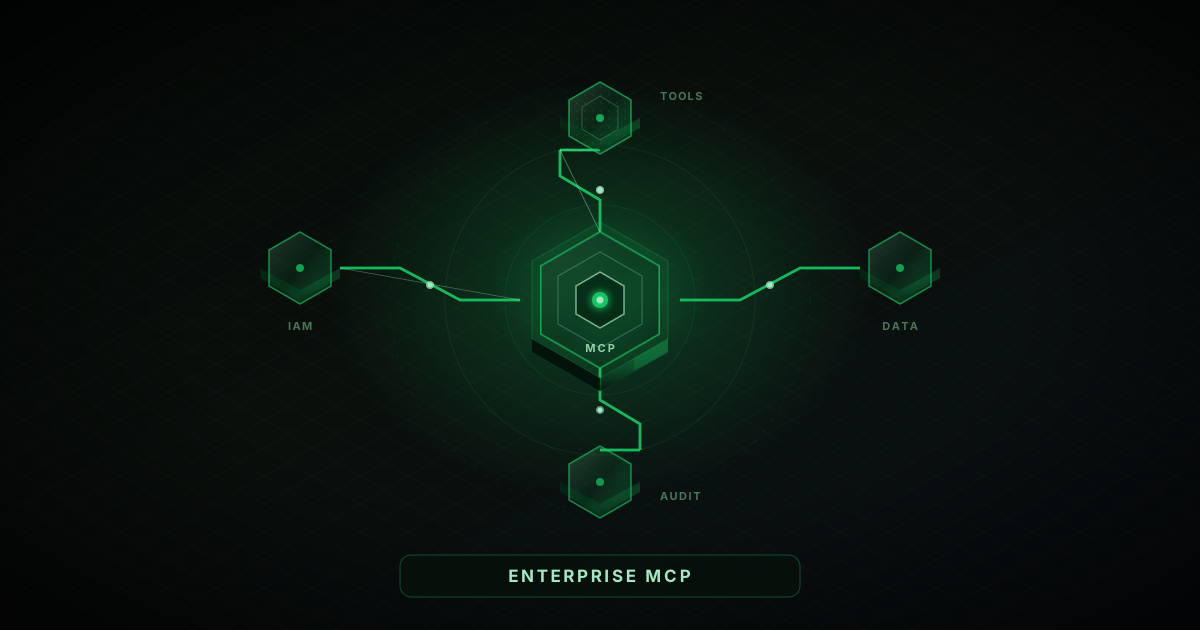
Enterprise MCP: wiring agents into the IS without Shadow AI
A standard tool contract, real user identity, a governed catalogue: how MCP lets you connect agents to the IS without opening the door to Shadow AI.
By Florian Gabon · September 16, 2026
AI for leaders as a trusted AI layer inside the IS
Shadow AI, prompt leakage, unsanctioned tools: the real risk is not the model, it is the missing controlled layer in the information system.
By Florian Gabon · September 11, 2026
n8n vs AI for leaders: automation vs AI agents
Complementary tools. Not substitutes, once you need governed enterprise AI.
By Florian Gabon · July 9, 2026