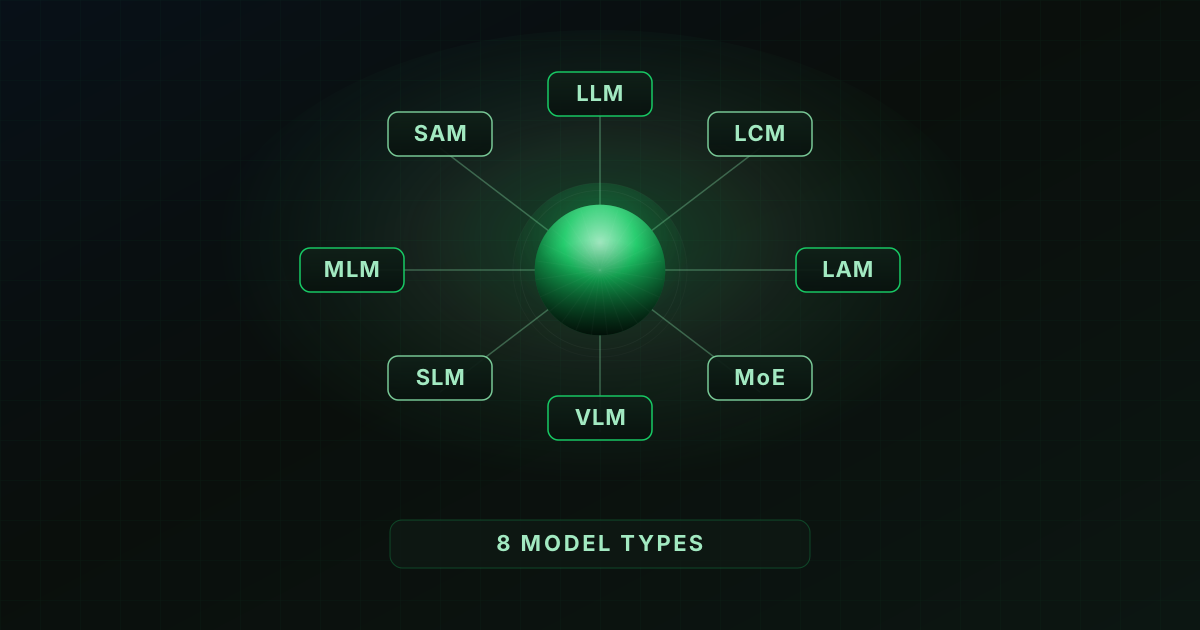
8 specialized AI model types
LLM, LCM, LAM, MoE, VLM, SLM, MLM, SAM: which family for which job, instead of one LLM for everything.
One LLM is not enough
In the enterprise, the default reflex is still familiar: wire up a large language model and ask it to do everything: draft, classify, extract, drive a tool, describe an image. It works in the demo. In production, costs spike, latency becomes unpredictable, and failures (vision, action, long context, small deployments) multiply without a clear diagnosis.
A mature AI platform no longer talks about a “single model”. It talks about a catalog of specialized families. Eight types show up across modern architectures: LLM, LCM, LAM, MoE, VLM, SLM, MLM, and SAM. Knowing what each one optimizes, and what it does not, avoids overpaying a giant LLM for a job a small local model, a mixture of experts, or a vision segmenter would handle better.
The eight families, in plain terms
LLM (Large Language Model): the text generator and linguistic reasoner. Ideal for synthesis, assisted drafting, Q&A, light planning. Limit: expensive and generalist; it is neither an action engine nor a vision specialist.
LCM (Large Concept Model): operates above tokens, on concepts or more abstract representations. Useful when the need is to connect ideas, policies, or long documents rather than produce sentence by sentence. Still emerging, but relevant for knowledge governance and multi-document reasoning.
LAM (Large Action Model): oriented toward execution: plan, then call tools, APIs, workflows. This is the family that brings the model closer to an operable agent. Without a scoped tool catalog and policies, a LAM is just an LLM improvising calls.
MoE (Mixture of Experts): an architecture that activates only a subset of experts per request. Goal: high capacity at a controlled inference cost, popularized in production systems such as Mixtral. In the enterprise, it is often the right compromise for a multi-team hub, provided you measure which experts are hit and under what load.
VLM (Vision-Language Model): joins image (or scanned document) and text. Concrete use cases: smart OCR, reading diagrams, support screenshot analysis, quality control. It does not replace a precise segmenter when the need is purely spatial.
SLM (Small Language Model): compact, fast models deployable on-prem / edge / private VPC. Perfect for classification, structured extraction, local assistants, pre-filters before an expensive LLM. Sovereignty and unit cost often start here.
MLM (Masked Language Model): understands text by predicting masked spans (the BERT tradition). Excellent for ranking, similarity, classification, NER, not for generating long prose. Often invisible in the stack, but critical in retrieval and scoring.
SAM (Segment Anything Model): object segmentation in images, near zero-shot, see Meta’s Segment Anything. Useful in industrial inspection, mapping, vision dataset prep. It is not a chatbot: it is a perception tool to plug into a pipeline.
Specialization vs monolith
One giant LLM for everything is expensive and hides failures. A family catalog makes each failure measurable.
Agents, RAG, vision: how to compose them
In practice, a platform like AI for leaders does not “pick one model”: it routes by task.
- A support agent reads a screenshot (VLM), extracts fields (SLM / MLM), drafts a reply (LLM), and opens a ticket (LAM + tools).
- Enterprise RAG uses an MLM / embedder for ranking, an LLM for synthesis, sometimes an LCM to connect cross-cutting policies.
- A factory quality check relies on SAM + VLM, with a local SLM for the structured verdict, without exporting images outside the perimeter.
The criterion is not “the largest model”, but the shortest path from business signal to controlled action: latency, token cost, data residency, auditability.
MoE and controlled cost
Activate only the experts that matter per request: high capacity without paying dense-giant inference on every call.
Enterprise selection criteria
Before adding a family to the catalog, ask four questions:
- Data perimeter: can the flow stay in your VPC / sovereign cloud? A self-hosted SLM or MoE often changes the decision more than an MMLU benchmark.
- Failure mode: what happens if the model hallucinates, misses a segmentation, or refuses a tool? Degraded modes must be defined per family.
- Unit cost: cost per 1,000 requests under real conditions (long context, images, retries), not the provider’s list price.
- Compliance: transparency, logs, human oversight. Some tasks quickly fall under the high-risk regime of the EU AI Act (Commission overview).
The classic trap: buying a premium VLM for pure text, or forcing an LLM to “see” via descriptions when SAM + business rules would suffice. The reverse exists too, multiplying specialists without a unified gateway, and ending up with an API-key jungle and no governance.
Conclusion
The eight types (LLM, LCM, LAM, MoE, VLM, SLM, MLM, SAM) are not a LinkedIn fad. They are the decision map for deploying AI in production without overpaying or under-securing. Maturity means a versioned catalog, routing policies, and evidence (latency, cost, audit) per family.
To continue on agent orchestration, see enterprise agent workflows; for the regulatory frame of deployment, the EU AI Act; for perimeter control, why sovereign AI matters.
Keep reading
Enterprise AI agents: workflows that hold up
Production agents need business tools, guardrails, and human checkpoints. A clever prompt is not a workflow.
By Florian Gabon · July 16, 2026

EU AI Act: practical compliance for the enterprise
Risk classes, duties, evidence. What the AI Act changes once AI is actually in production.
By Florian Gabon · August 4, 2026
Why sovereign AI matters for enterprise
The chatbot is no longer the brief. Teams need a platform where data stays under their control.
By Florian Gabon · August 6, 2026