Enterprise AI agents: workflows that hold up
Production agents need business tools, guardrails, and human checkpoints. A clever prompt is not a workflow.
From chatbot to operable agent
A chatbot answers. An agent acts: it calls APIs, chains steps, asks for human validation when risk rises, and leaves a trail support can reread. That difference is what decides whether the project reaches production. Business teams have moved past the decorative dialog box. They need a workflow that opens the right ticket, finds the right procedure, updates the right field, and stops cleanly when rights or data are missing.
Enterprise agents must therefore call tools with scopes, respect quotas, and fail explicitly. An ERP timeout or IAM denial is not a “hallucination”: it is an operational signal. If the platform does not surface it in a clear timeline, the agent stays a POC, impressive in the demo, opaque on the first Friday-night incident.
Scale adds another constraint: multiple teams, multiple tool catalogs, multiple criticality levels. Without shared governance, every project reinvents its guardrails, and IT ends up with exactly the fragmentation it tried to avoid.
Orchestration: plan, tools, policies
The architecture that holds up separates three loops, versionable independently:
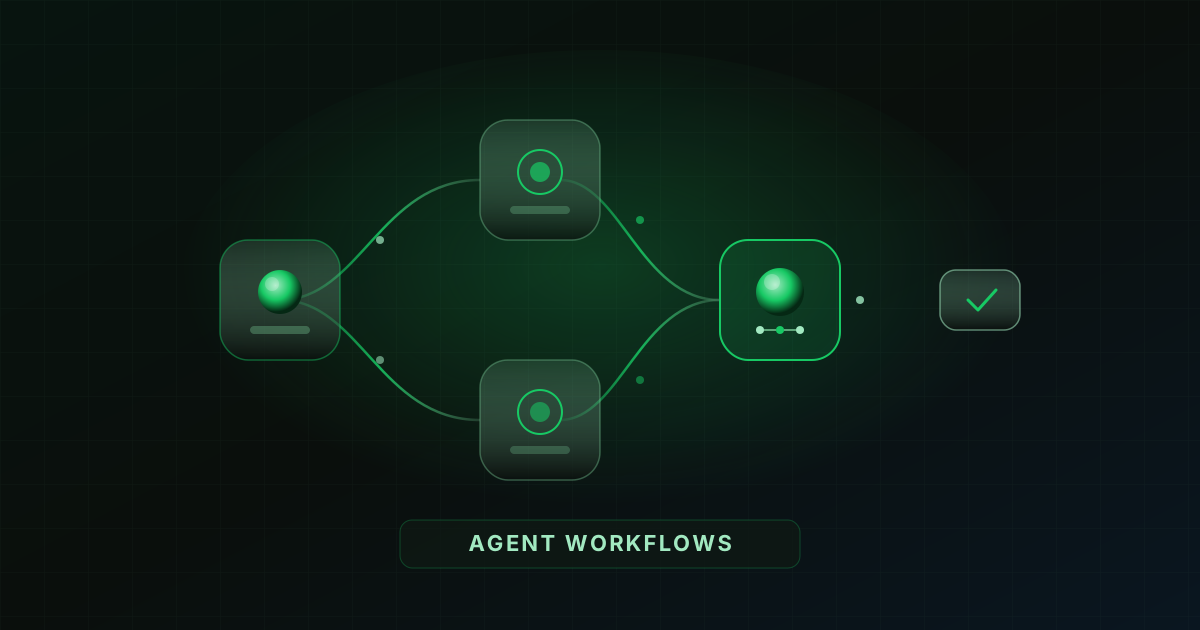
- Planning: the agent decomposes the request (search, compare, act, verify). The plan must be inspectable: you want to know what the agent intended to do before it does it.
- Tool execution: each action (search doc, create ticket, read customer record, post a comment) is a scoped connector, with input/output schema and a business owner.
- Policies: token quotas, per-role tool allowlists, approval thresholds, denials for out-of-catalog actions.
Without that separation you get a fragile mega-prompt: everything lives in context, nothing is auditable, and the smallest business change (new ERP field, new HR policy) breaks behavior invisibly. With it, you can unit-test policies, publish a tool behind IAM review, and replay an incident step by step, closer to the spirit of the ReAct loop (reason → act → observe) than to a single opaque completion.
Connectors should reuse the end-user identity (delegation / OBO) rather than an omnipotent service account. Otherwise the agent becomes a shortcut around IAM, exactly what IT and compliance will reject. When a tool writes to a critical system, also require idempotency or a correlation id: retries must not create three tickets for one request.
Scoped tools
Every action (create ticket, search doc) is bounded by the user's role, like your existing apps.
Autonomy modes and checkpoints
Not every use case needs the same autonomy. Forcing autonomous everywhere creates incidents; keeping everything assisted creates friction and abandonment. Three modes cover most needs:
- Assisted chat: the agent proposes a plan and actions; a human validates each sensitive step. Ideal for early journeys and regulated domains.
- Semi-autonomous: free chaining for search, synthesis, and reads; human approval before any write (ticket, external email, ERP update).
- Bounded autonomous: low-risk actions inside a closed catalog (open a tier-1 ticket from a template, classify a request, enrich a record with non-critical fields).
Long workflows need explicit checkpoints: plan → act → verify. Define what is irreversible (payment, deletion, out-of-perimeter send, permission changes) and force approval with an identifiable owner. Document rollback: cancel a created ticket, restore a status, notify the requester, compensate a partial write.
The mode is not frozen forever: a use case can start assisted, then move semi-autonomous once tools are stable and error rates are under control. Measure that rate, not only conversational satisfaction.
Autonomy levels
Chat, assisted, or autonomous: AI for leaders adjusts autonomy by use case and criticality.
“The agent isn't magic, it's an orchestrator with rules.”
What breaks in production (and how to harden)
Recurring failure modes, usually visible within the first months:
- Tool loops: the agent recalls the same API with no progress; enforce per-session call ceilings, a circuit breaker, and an explicit failure message.
- Context saturation: too many RAG chunks + long history; truncate with priority to citations, the current plan, and the last action, not a chronological dump.
- Rights drift: a tool added “quickly” without IAM review or owner; require a publish checklist (scope, data touched, logs, rollback).
- Opaque silence: model or tool down; show a clear degraded mode instead of inventing an answer or spinning forever.
- False success: the tool returns 200 with a partial payload; validate business invariants after the call (ticket created with the right queue, attachment present, etc.).
N2 support needs a timeline: user input, plan, tool calls (status, latency, correlation id), policies fired, outputs, human approvals. Without that, every incident becomes another prompt-engineering session, expensive and non-transferable.
Governance and selection criteria
Evaluate an agent platform on evidence, ideally on a pilot inside your stack, using a governance frame such as the NIST AI RMF:
- IAM propagation through tools and retrieval, with non-regression tests on contrasting profiles.
- Versioned tool catalog with business owners and publish history.
- Budgets and quotas per team / use case, visible to IT.
- Audit export for compliance, accreditation, and post-mortems.
- Deployment inside your perimeter (on-prem / sovereign cloud), not only an opaque SaaS.
- Model fallback strategy and behavior under load (queues, priorities, clean rejection).
- Clean contracts to expose existing automations as tools (events, APIs, optionally MCP).
AI for leaders positions here: an agentic layer with built-in governance, RAG, and a model gateway on the same foundation, versus generic copilots that excel at chat but underinvest in operability, audit, and perimeter control.
A practical pilot sequence helps: start with a read-only assisted agent on one high-value process (procedure Q&A + ticket draft), measure citation quality and tool error rates for two weeks, then unlock a single write action behind human approval. Only after N2 can diagnose failures from logs should you expand the tool catalog or raise autonomy. That staged path protects trust better than a big-bang “autonomous agent for everything” launch.
Also budget for ownership: every tool and every policy needs a named business owner and an IT counterpart. Without that, the catalog grows faster than the review capacity, and “temporary” exceptions become the real production path.
Conclusion
Enterprise agents win when they plug into the existing systems with governance in the same platform: scoped tools, explicit autonomy modes, replayable audit, readable failures. Prompts remain necessary. They are no longer enough to reach production.
For the contrast with deterministic automation, see n8n vs AI for leaders; to ground answers in your sources, enterprise RAG patterns.
Keep reading
Why sovereign AI matters for enterprise
The chatbot is no longer the brief. Teams need a platform where data stays under their control.
By Florian Gabon · August 6, 2026
Enterprise RAG: 3 patterns that survive production
A RAG demo is easy. Production is won or lost on source governance: rights, versions, citations.
By Florian Gabon · July 30, 2026
Data and AI: the sovereign perimeter
Where data lives, how it is encrypted, who can reconstruct a request: the perimeter that makes enterprise AI credible.
By Florian Gabon · July 23, 2026