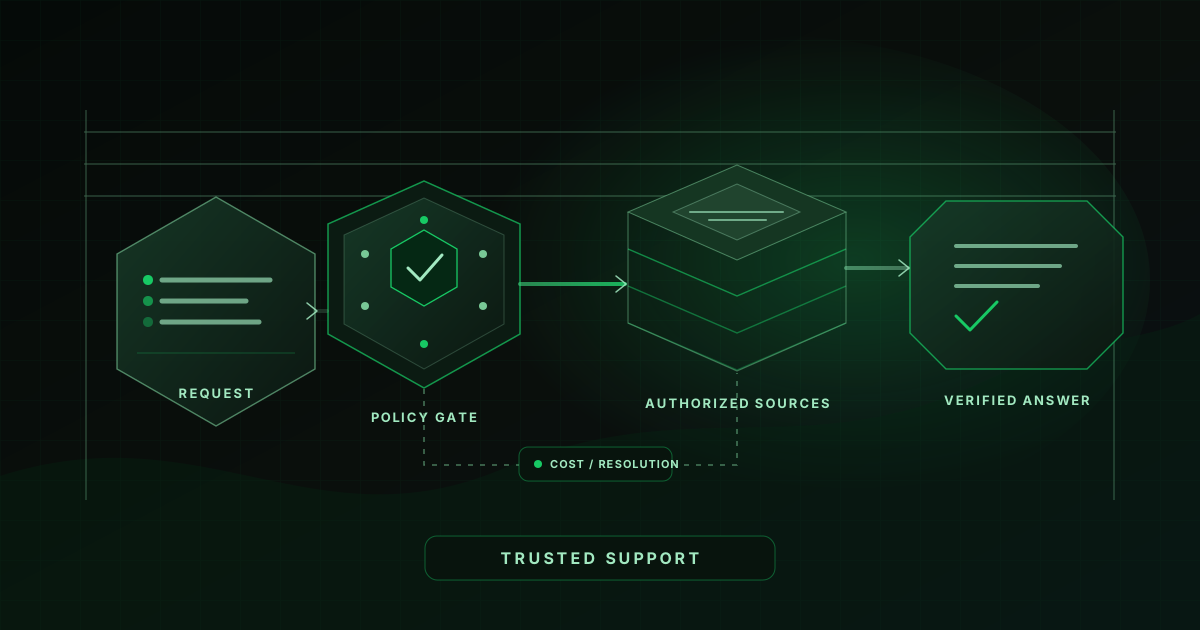
Internal support assistant: trusted answers, controlled costs
Design an internal support assistant around authorized sources, human escalation, and cost per resolved request.
An internal support assistant can find a procedure, explain a policy, or route a request. But a fast answer is worthless if it relies on an inaccessible document, hides uncertainty, or costs more with every retry. The goal is not “answer everything”; it is to resolve eligible requests using authorized sources at an explainable cost.
Consider an illustrative scenario, neither a real customer story nor a measured result: a company wants to help employees with questions about tools, purchasing, and leave. Requests arrive through a portal and messaging; answers live in document spaces with different permissions. The pilot should reduce repetitive searching without replacing people who interpret exceptions.
Design source scope, access, escalation, and measurement together. As with enterprise RAG patterns, value here is a resolved request—not a retrieved chunk or generated message.
Start with requests, not the model
Before connecting a corpus, sample recent requests and anonymize them under internal rules. Group by intent—find information, compare, troubleshoot, request a decision, or report an individual situation—and have support validate the categories. The same wording can hide a missing permission, exception, or action.
Select frequent intents with maintained answers and reversible errors. For example: level-one internal-tool questions, during business hours, read-only for authenticated employees, transferred to support if a procedure is missing. Exclude individual HR decisions, legal advice, access changes, urgent issues, and unapproved writes.
Write entry and exit criteria the business can apply. A request is “eligible” if its intent is catalogued, the user authenticated, and an approved source available. It is “resolved” only when the user confirms the answer or an outcome is verified, such as the right ticket created. A displayed answer is not a resolution.
Also name population, languages, channels, hours, source owners, trace retention, and service owner. This contract prevents quiet expansion into riskier topics because the model appears able to answer them.
An answer is not a resolution
Count a closed request confirmed by the user or verified in the business process—not a generated message or displayed citation.
Sources and permissions: do not create a parallel corpus
The assistant need not index all internal knowledge. It needs governed sources with owners, status, review date, authorized audience, and removal process. A current FAQ beats an archive of contradictory policies.
Connect sources to their systems of record and access rules. Establish identity and groups, then enforce permissions before sending excerpts to the model. A “do not reveal confidential information” prompt does not enforce ACLs. Remove expired documents or those with stale permissions from retrieval; check synchronization and handle failures explicitly.
Answers should cite a specific passage and link to its source. Distinguish supported claims from explanation. If sources conflict, are outdated, or too general, say so and route to a person. Similarity scores do not prove correctness: review passages and responses on representative requests.
The CNIL's guidance on developing AI systems emphasizes data protection throughout a project. Review purposes and legal basis with the DPO; minimize personal data in requests and logs, inform employees, restrict trace access, define retention, and handle data-subject requests. Do not automatically send personal details in a support question to every component.
Authorize before retrieval
User identity and source ACLs govern retrieval; the model must never be the access-control mechanism.
Route by task and make limits explicit
Not every request needs the same model or autonomy. A short lookup may need targeted retrieval; comparing procedures may need multiple sources and review. Changing access, approving purchases, or updating HR data belongs in a controlled workflow, not ordinary chat.
Route by intent, sensitivity, source availability, confidence, and maximum cost. Limit retries, context, and tools. Do not automatically escalate to a costlier model until an answer appears; after failed search or conflicting evidence, support may be the best destination.
Define “insufficient confidence”: no authorized source, outdated passage, irrelevant citations, out-of-scope question, conflict, or unverifiable outcome. Explain the next step instead of showing an abstract score. Subject to privacy rules, prefill a support ticket with the question and sources so the employee need not repeat the history.
Name an owning queue, pass minimum context with the reason (missing source, exception, risk, or failure), and set hours and response targets. Define how to resume conversations and work when a component is unavailable. Do not claim resolution if a person must still decide.
The NIST AI Risk Management Framework structures risk identification, measurement, and management. Use it as a working framework, not pilot certification: test leakage and wrong answers with contrasting access profiles, assign remediation owners, and retain a disable option.
Run a pilot that learns without widening risk
A useful pilot compares assisted handling with the current process on requests from the same categories. Set a baseline first: volume and handling time, transfers, reopenings, and support effort, noting the limits of each measure. Then start in observation or read-only mode: support staff see proposed answers, check them, and record whether they would accept them. This lets the team inspect failure modes before an unverified answer is presented to employees as official guidance.
As answers pass checks, open a subset of intents to a small, representative group. Keep a straightforward human route and collect specific feedback rather than a thumbs-up alone: correct answer, wrong source, missing document, ambiguous request, or correct but unusable answer. Assign an action to every category. A missing document goes to its owner; an ACL problem to IT; recurring ambiguity to the business owner to refine the intent catalogue.
Agree on go/no-go thresholds before reviewing outcomes: citation quality, appropriate escalation, no leakage in tests, maximum cost, and available support capacity. At planned checkpoints, decide whether to continue, fix, keep scope unchanged, or stop. If a measure is missing, do not interpret that as success; instrument it before expansion. A short, reversible pilot teaches more than a broad launch where adoption, workload shifting, and genuine resolution become difficult to distinguish.
The operational boundary should include a change process. Version the approved source list, routing policy, prompt or instructions, evaluation set, and budget limits. When a policy or source changes, record who approved it, replay affected test cases, and watch the first live requests more closely. A rollback should restore the previous known-good configuration, not merely disable the assistant while employees are left wondering where to go. Define an owner who can pause the feature outside a scheduled review if a permission defect, harmful answer, or unexpected cost spike appears.
Measure cost per request actually resolved
Cost per resolved request is an operating metric, not a savings promise. Agree on the formula with Finance and support before comparing the pilot with the baseline:
Full cost of the scoped service during the period ÷ eligible requests resolved during that period.
Include attributable model licences or usage, search, storage, connectors, gateway, observability, infrastructure, amortized integration, maintenance, support, and human review. Show shared costs separately under a documented allocation rule. Avoid double counting without treating operations as free.
Count unique eligible requests resolved—not messages. Each can trigger attempts, searches, tool calls, or transfers that consume tokens and support time. Keep events visible, deduplicate follow-ups, and set a resolution window suited to the process.
Track eligibility, confirmed resolutions, transfers, reopenings, corrections or rejections, citation quality, human review, latency, and model cost. Segment by category and team; an average can hide exceptions that absorb the budget.
“Time saved” is easy to overstate. Measure handling time before and during the pilot consistently, separating removed time from time shifted to review. Easier access may also increase questions. Report these effects separately; estimates are not realized savings.
For a reproducible calculation, keep a pseudonymous request-level ledger with entry and closure times, category, attempts, billed tokens or units, review minutes, outcome, and transfer reason. It need not retain every conversation: separate support data from measurement events and apply the retention rules already defined. Finance can reconcile aggregate usage with invoices, while the business can check whether requests marked resolved actually were. That makes a billing discrepancy investigable without retaining more content than necessary.
Make denominator rules explicit for partial outcomes. If a person resolves the request after the assistant drafts a useful but incomplete answer, record the human resolution and review effort rather than crediting the assistant with a full resolution. If the user disappears, classify the request as unconfirmed or unresolved under a pre-agreed rule instead of silently counting it as successful. Keep these categories visible in reporting; changing the rule between the baseline and pilot makes the comparison misleading.
Set a period budget and ceiling per request or category. Alert before a breach, cap retries, and pause automation cleanly at the limit. Review outliers, not only average cost. The total-cost comparison for AI licences and tokens separates fixed costs, variable costs, and retries.
Shared responsibilities, with named decisions
IT owns integration, identity, connectors, security, and observability. It must trace sources, versions, and policies, and disable an integration without taking down support.
Finance validates cost conventions, allocations, budget, and telemetry-to-invoice reconciliation. It separates setup and training from recurring costs and assigns alert and approval owners.
Support's business owner selects eligible intents, validates answers, defines resolution, names owners, and reviews failures. They decide when to clarify or remove a source, exclude a case, or change a rule. DPO, security, and HR contribute where relevant.
Test anonymized requests, contrasting access profiles, outdated sources, ambiguities, and cases to refuse or transfer. Have business owners review the set and replay it after index, model, or policy changes; measure refusals and escalations as well as correct answers.
Checklist before expanding the pilot
- Use case — intents, exclusions, and a testable resolution definition are agreed.
- Sources and access — owners, status, removal, and pre-generation ACL tests are in place.
- Answers and routing — citations are verifiable; conflicts, gaps, and sensitive cases escalate.
- People — queue owner, minimal context, hours, degraded mode, and emergency stop are defined.
- Measurement — comparable baseline, full cost, retries, review, reopenings, and resolutions are tracked.
- Budget — ceilings and alerts have owners; no silent overspend.
- Evaluation — versioned tests cover permissions, stale sources, and refusals.
- Review — IT, Finance, and the business owner decide whether to continue, fix, or stop.
Conclusion
A useful internal support assistant is not a universal answer engine. It is a governed journey: selected requests, authorized sources, verifiable answers, handoff when the system reaches its limits, and financial measurement at the level of resolved requests. Start narrow, make retries and costs visible, and expand only when permissions, human experience, and operations are demonstrably under control.
For retrieval design, explore enterprise RAG patterns; for the responsibilities of more autonomous workflows, see enterprise AI agents.
Keep reading
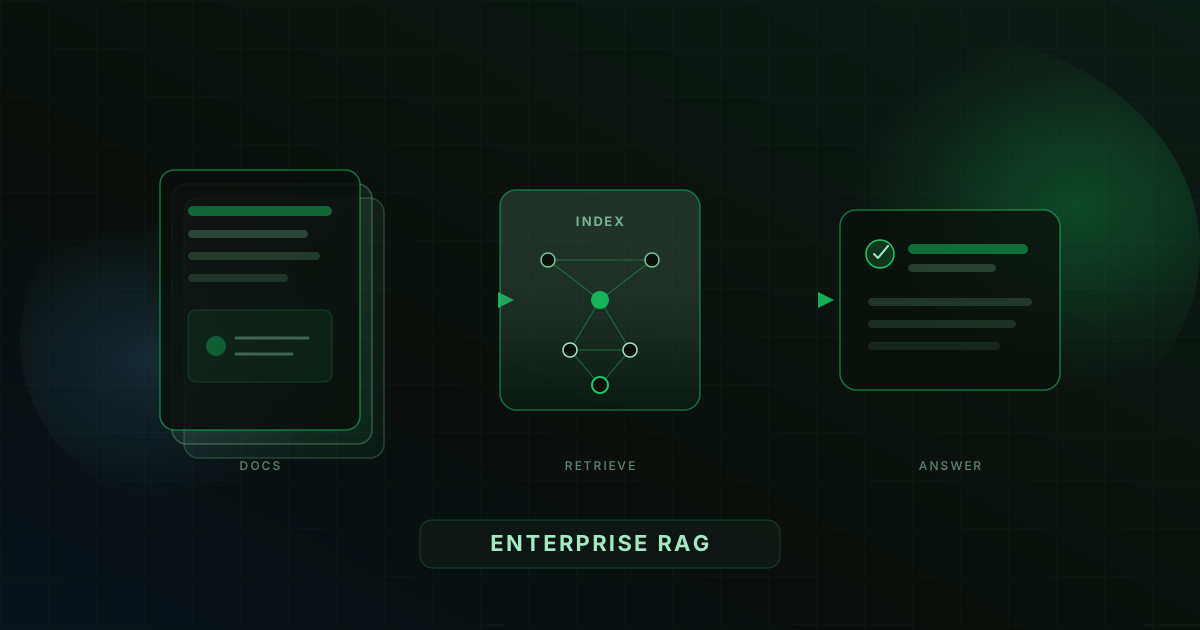
Enterprise RAG: 3 patterns that survive production
A RAG demo is easy. Production is won or lost on source governance: rights, versions, citations.
By Florian Gabon · July 30, 2026
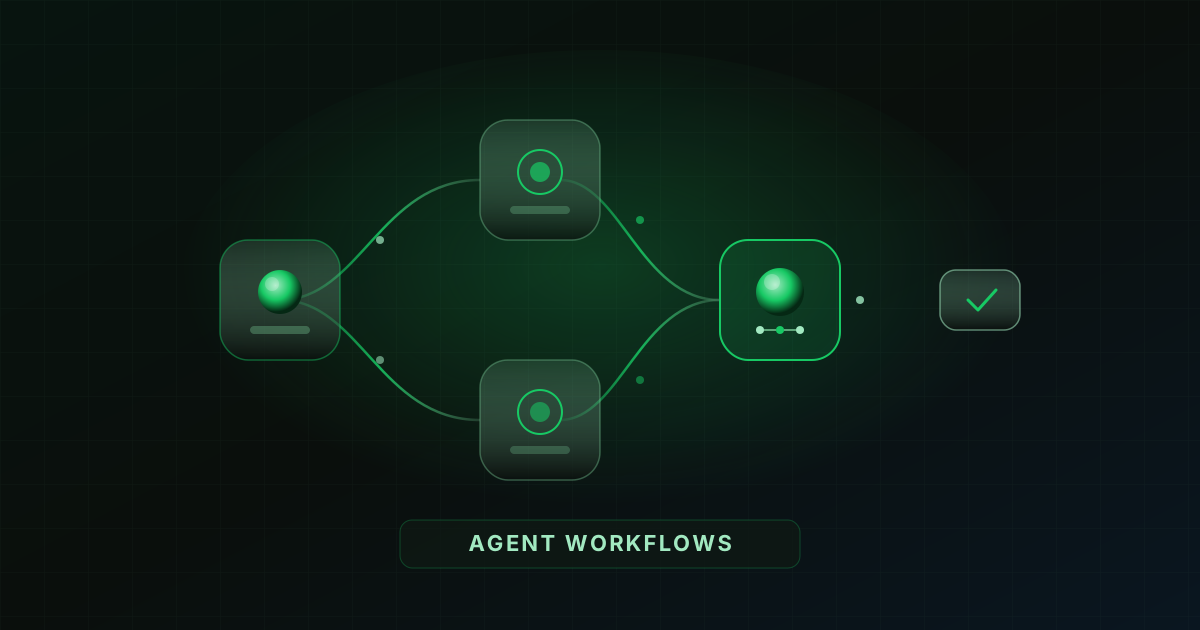
Enterprise AI agents: workflows that hold up
Production agents need business tools, guardrails, and human checkpoints. A clever prompt is not a workflow.
By Florian Gabon · July 16, 2026
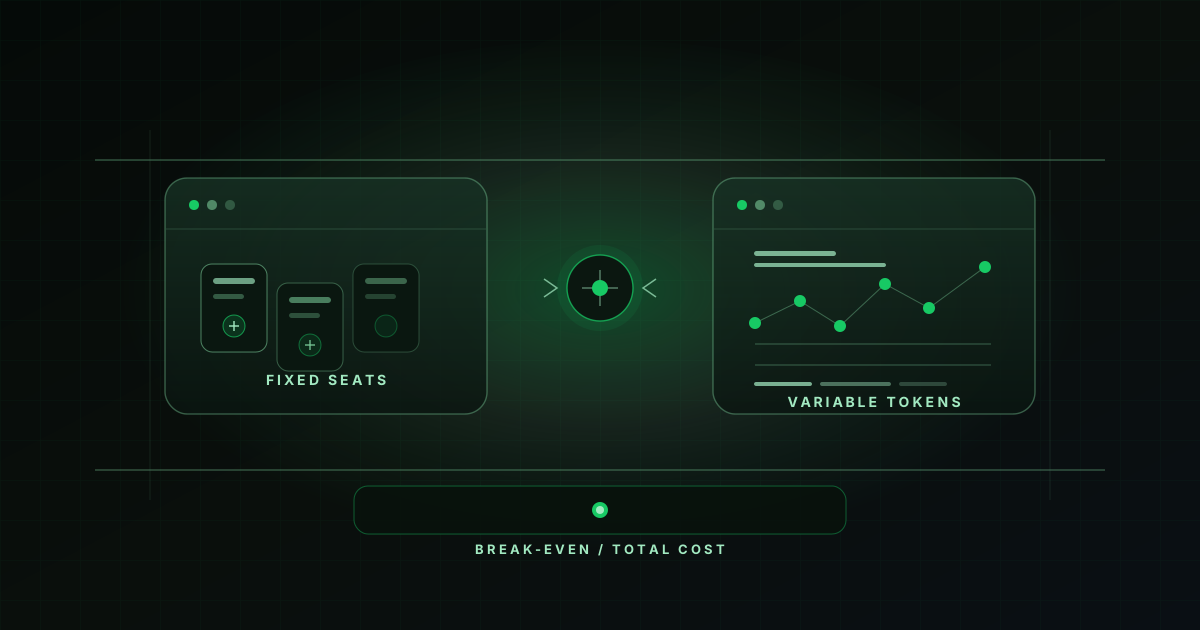
AI seats or tokens: calculate total cost without a false comparison
A reproducible way to compare a per-seat plan with usage billing, without confusing list price with total cost.
By Alexandrine Marjollet · November 5, 2026