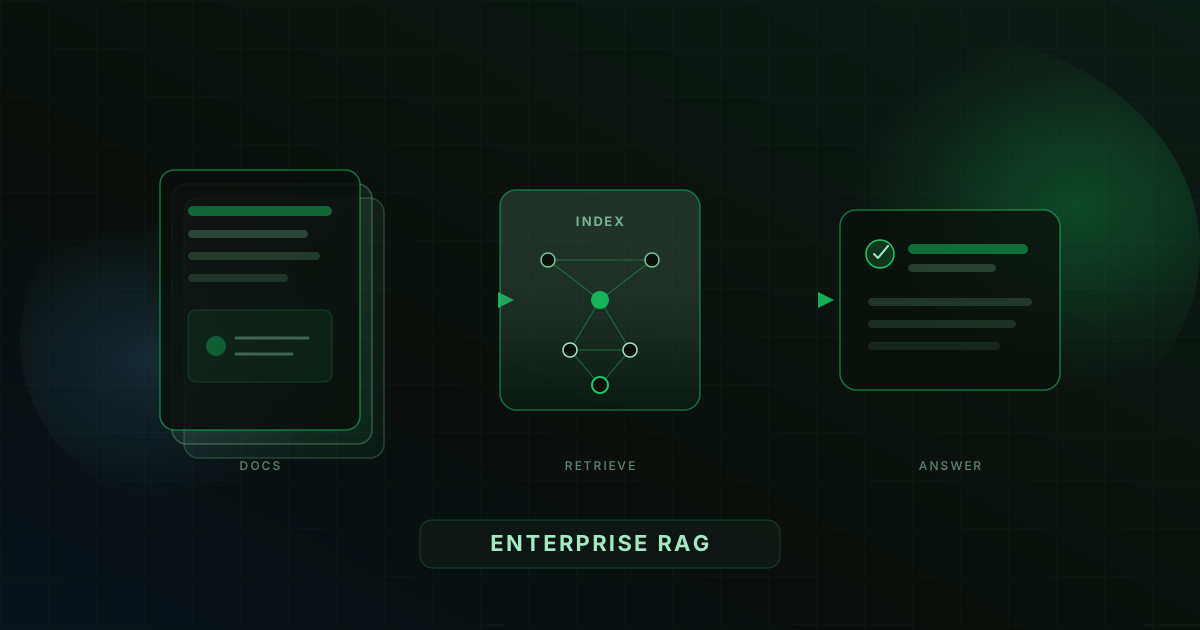
Enterprise RAG: 3 patterns that survive production
A RAG demo is easy. Production is won or lost on source governance: rights, versions, citations.
Beyond “dump PDFs in a bucket”
A RAG POC looks great: index a folder, ask three questions, the model answers confidently. In production, the same pipeline breaks as soon as heterogeneous rights, stale documents, messy business formats (tables, multi-page procedures), and teams who demand source verification before acting show up. Enterprise RAG is not an embedding script. It is a knowledge-governance product, far beyond the original RAG paper demo setup.
Without per-team boundaries, versioned sources, and verifiable citations, hallucinations become operational risk: an invented HR procedure, a misattributed contract clause, a “plausible” answer grounded in a document the user was never allowed to see. The cost is not only reputational, it is N2 time, skewed business decisions, and a project freeze after the first serious incident.
The three patterns below are what we see in organizations that actually cross the first thousands of users.
Pattern 1: IAM-scoped sources
Every connector (DMS, SharePoint, ERP, internal wiki) must expose access scopes aligned with existing IAM. The agent only sees what the user can already access. In practice: the retrieval filter applies groups and ACLs before semantic ranking, not after generation with a late redaction step. Filtering too late means sensitive content has already entered the model context.
Classic production failures:
- Indexing “the whole drive” with a service account, then filtering too late → latent leakage into the prompt.
- Duplicating rights into a second tagging system → drift after the first HR change or external share.
- Mixing public and confidential spaces in one index without namespaces → retrieval pollution and false confidence.
- Leaving “broken” documents (orphan ACLs, dead links) in the index months after business withdrawal.
The robust pattern: namespaces or collections by domain, sensitivity metadata, periodic ACL sync from the system of record, and non-regression tests across contrasting user profiles. When someone leaves a team, retrieval follows, without a manual index rebuild.
Mandatory citations
Every RAG answer must link to a source document, otherwise business teams will not sign off on rollout.
Pattern 2: Versioned ingestion and targeted reranking
Retrieval quality depends as much on ingestion as on the model. Naive chunking (random PDF page splits, titles separated from body) destroys tables, control lists, and procedure headers. In enterprise settings, version your sources: publish date, owner, status (draft / published / archived), and remove obsolete versions from the index instead of letting them compete with current chunks.
After dense retrieval, or hybrid BM25 + vectors, often more robust on business acronyms, a lightweight reranker cuts noise without blowing up latency. Often the highest-ROI lever before switching models: less useless context, fewer hallucinations glued to the wrong excerpt, better token cost control, shorter and more actionable answers. For the classic lexical baseline behind hybrid search, see BM25.
Operational checkpoints to agree with the business:
- Alerts when the rate of answers without a usable citation rises above a threshold.
- p95 latency for retrieval + rerank under a budget (often more critical to UX than generation time).
- Replay a golden question set after every major re-ingestion or chunking change.
- Measure “stale hits”: answers that still cite an archived version.
Pattern 3: Answer governance and audit loop
The third pattern rarely appears in tutorials: treat every answer as an auditable event. Who asked what, which chunks were injected (ids, scores), which citations were shown, which model generated the output, which policies blocked an action. Without that, N2 support can neither explain nor fix an incident, and compliance cannot demonstrate control, the governance mindset captured in the NIST AI Risk Management Framework.
Add business guardrails: explicit refusal when no source meets a score threshold; “citations only” mode for regulated domains; human escalation when confidence is low or the question falls outside the catalog. User feedback (useful / wrong / out of scope / bad source) must flow back into the ingestion and curation backlog, not only into a vanity dashboard.
On the platform side, this also means trace retention (duration, encryption, who can export) and failure scenarios: DMS connector timeouts, index drift after a SharePoint migration, load spikes that stretch rerank latency, primary model unavailable. Plan a degraded mode (shorter answers, queueing, clear messaging) instead of opaque silence or confident invention.
Governance in the same layer
Policies, logs, and perimeters in the same layer as the index, not an export script bolted on afterward.
Putting the three patterns together
In a mature rollout, the patterns reinforce each other. IAM-scoped sources keep retrieval honest; versioned ingestion and reranking keep answers current and concise; audit and guardrails make incidents explainable. Skip any one leg and the system looks fine in a pilot, then fails under real ACLs, real document churn, or the first contested answer in a regulated process.
Treat the golden question set as a release gate: new connector, chunking change, or model swap must not regress citation rate, stale-hit rate, or p95 latency beyond agreed budgets. That discipline is what separates a platform RAG from a notebook demo.
Conclusion
Enterprise RAG is a knowledge governance product, not an embedding script. IAM perimeter, versioned ingestion with reranking, and answer audit form the trio that survives scale. Models change every quarter; these patterns remain and harden with volume.
AI for leaders positions RAG as a platform layer: connectors, indexes, permissions, and audit in one sovereign perimeter, so moving from POC to prod is not a rewrite. For residency around those indexes, see also our piece on the sovereign data perimeter.
Keep reading
Why sovereign AI matters for enterprise
The chatbot is no longer the brief. Teams need a platform where data stays under their control.
By Florian Gabon · August 6, 2026
Data and AI: the sovereign perimeter
Where data lives, how it is encrypted, who can reconstruct a request: the perimeter that makes enterprise AI credible.
By Florian Gabon · July 23, 2026
Enterprise AI agents: workflows that hold up
Production agents need business tools, guardrails, and human checkpoints. A clever prompt is not a workflow.
By Florian Gabon · July 16, 2026